
|
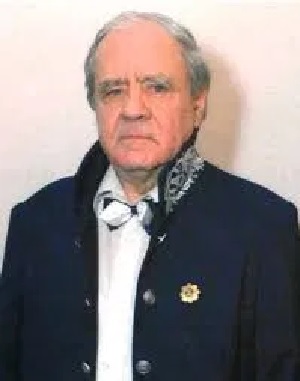
(December 8, 1937, Cotiujenii Mari, Soldanesti district, Republic of Moldova) Physicist, scientific area: solid state physics.
|
 |
In 1954, he graduated from the secondary school in Cotiujenii Mari, and in 1959 from the Faculty of Physics and Mathematics, Department of Physics, at the Moldova State University. He pursued doctoral studies at the Institute of Semiconductor Physics of the Academy of Sciences of Ukraine (Kyiv, 1962–1965).
He worked as a laboratory assistant and senior laboratory assistant at the Institute of Chemistry of the Academy of Sciences of Moldova (1959–1962), senior engineer and junior research scientist at the Moldovan branch of the All-Union Scientific Research Institute of Current Sources (1965–1969), senior research scientist at the Institute of Applied Physics of ASM (1969–1977), associate professor (1977–1984), full professor (1984–2005), head of department (1976, 1977), and head of the newly established laboratory “Superconductivity and Magnetism” (1993–2005) at the Faculty of Physics of the Moldova State University.
Between 2005 and 2008, he served as Director of the Center for Metrology and Analytical Research Methods of ASM. In 2006, within the Center, he founded a new research laboratory “Magnetic Resonance and Laser Spectroscopy,” which he headed until 2012. In 2008, the laboratory was transferred to the Institute of Chemistry as part of the Laboratory of Quantum Chemistry, Chemical Kinetics, and Magnetic Resonance. Since 2013, he has been a principal research scientist in the Laboratory of Physical and Quantum Chemistry at the Institute of Chemistry of MSU.
Corresponding Member Ion Geru is a renowned scientist in the field of condensed matter physics and magnetic resonance processes, founder of new scientific directions: “Giant spin splittings in semimagnetic semiconductors” and “Microwave and radio-wave spectroscopy of excitons in semiconductors.” His research areas include symmetry theory, microwave and radio-wave spectroscopy of solids, the study of electrical and magnetic properties of high-temperature superconductors, optical spectroscopy of fullerenes, and research on molecular magnets.
Among his fundamental scientific results are: the prediction of magneto-acoustic electron-nuclear double resonance in condensed media and radio-optical double resonance of excitons, later experimentally confirmed; identification of only four magnetic symmetry groups in four colors for systems with Kramers degeneracy of energy levels (instead of the traditionally used 58 two-color groups); development of a method for controlled modification of magnetic ordering in dimeric clusters; identification of a new type of degeneracy of quasi-energy levels and bands caused by the non-commutation of the time-reversal operator with time-translation operators.
He is the author of the new scientific concept of “partial time-reversal,” confirmed experimentally. Based on group theory, he demonstrated that due to time-reversal symmetry, certain spatial orientations of magnetic moments of paramagnetic ions in clusters with Kramers degeneracy are forbidden. This selection of allowed orientations can be interpreted as a result of a previously unknown correlation between the properties of the time-reversal operator and the structure of four-color magnetic symmetry groups. Another consequence of time-reversal symmetry is the stability of spin level populations in quantum systems with Kramers degeneracy against structural distortions.
He has published over 350 scientific papers, including three monographs and more than 200 articles in journals such as ZhETF, Doklady AN SSSR, FTT, FTP, Izvestiya AN SSSR, Ukrainian Journal of Physics, Theoretical and Experimental Chemistry, Journal of Structural Chemistry, Journal of Inorganic Chemistry, Superconductor Science and Technology, Physica C, International Journal of Modern Physics B, Journal of Alloys and Compounds, Journal of Superconductivity, Sensors and Actuators, Molecular Materials, Fullerene Science and Technology, International Journal of Modern Physics Letters B, Applied Magnetic Resonance, Balkan Physics Letters, Romanian Journal of Physics, and Romanian Reports in Physics. He has presented his results at 45 international scientific conferences and supervised 5 PhD theses and one Doctor Habilitat thesis in physical and mathematical sciences.
Between 1968 and 2005, he carried out extensive teaching activity through lecture courses (general physics, theoretical mechanics, astronomy, group theory, oscillation theory, magnetism theory, technical electrodynamics, fundamentals of modern physics, quantum mechanics, statistical physics, magnetic resonance, nonlinearities in solids, etc.) delivered at the Moldova State University, Technical University of Moldova, Tiraspol State University (based in Chișinău), and “Alexandru Ioan Cuza” University of Iasi. He was awarded the Order “Gloria Muncii”.
References
- Geru, Ion; Shter, Dieter. Resonance Effects of Excitons and Electrons. Basics and Applications. Eds. SPRINGER Science-Business media B.V. 2013, 283 p., ISSN 1616-6361, ISBN 978-3-642-35807-4.
- Geru, Ion. Repere pe axa timpului. Tipografia AŞM, Chişinău, 2013, 276 p. ISBN 978-9975-62-335-3.
- Geru, Ion. Transactions on metrology and analytical methods of research. Tipografia AŞM Chişinău 2010, 283 p. ISBN 978-9975-62-276-9.
- Academia de Științe a Moldovei. Academicieni și membri corespondenți. Duca Gh. (coord.), Chișinău, 2015, 192 p.
- Aricu A., Nastas R., Cocu M. The Institute of Chemistry at 60 years anniversary. Brief history, achievements and perspectives. Chemistry Journal of Moldova, 2019, 14(1), p. 8-31. doi: http://dx.doi.org/10.19261/cjm.2019.349.
- GERU, I.I. Application of the EPR Method to Identify Virtual Time reversal. In: International Seminar dedicated to the 80th anniversary of the discovery of Electron Paramagnetic Resonance, October 29, 2024, Scientific Center of the Academy of Sciences of Ukraine, Kyiv, Ukraine, У-6, p. 10.